


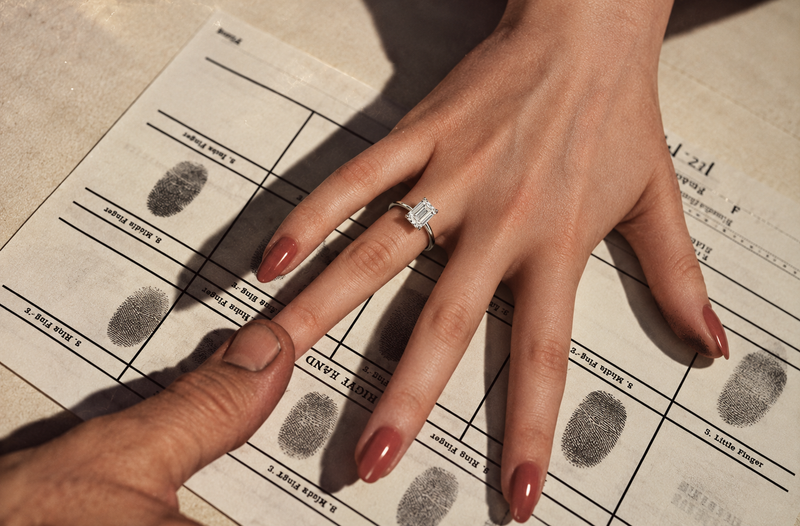


How Much Does an Engagement Ring Cost?
What actually drives the price of an engagement ring: the setting, the diamond, lab grown or natural, and the metal. Plus a simple way to set your budget.
The short answer: an engagement ring costs whatever the setting costs plus whatever the diamond costs, and the diamond is where almost all of the range comes from. Lab grown or natural is the single biggest lever, then carat, then colour and clarity. At OLVR the setting is a fixed price and the diamond is priced separately, so you see both before you commit.
The old "two months' salary" rule was a marketing line. Spend what makes sense for you, and know what you're paying for.
The two parts of the price
Every engagement ring is two purchases in one: the setting (the band and the part that holds the stone) and the centre diamond. At OLVR they're priced separately so you can see exactly where your money goes.
1. The setting
The setting is a fixed price for each style, and it changes with how much metal and how much hand work goes into it.
- Solitaires sit at the low end. A single stone on a clean band, like our NOVA Solitaire and TERRA Solitaire.
- Pavé, channel and double bands sit in the middle, because of the extra small diamonds set by hand along the band.
- Our PETRA styles sit at the top. They're bold, sculpted bands with more metal in them.


Metal and centre stone shape can move the setting price a little. You can see the current price of every style in our NOVA, TERRA and PETRA collections.
2. The diamond
This is where the range opens up. Price is driven by carat first, then colour and clarity, then cut. It climbs quickly as you go up in size, and two diamonds of the same carat weight can be priced very differently. Every diamond we sell is certified by IGI or GIA, so the grade you pay for is the grade you get, and you'll see the exact price of each stone before you choose it.
Lab grown or natural
This is the single biggest lever on price. Lab grown diamonds are real diamonds, chemically and optically the same as mined ones, and cost far less for the same size and grade. A lot of couples choose lab grown and put the difference into a bigger stone or a better setting. Natural diamonds are available if that matters to you. Our guide to lab grown vs natural diamonds walks through the trade-offs honestly.
What else affects the total
- Metal. Every ring style comes in 18k yellow gold, 18k white gold, 14k rose gold or platinum.
- Bespoke design. A ring designed from scratch costs more than building one of our styles, because of the design rounds and one-off production.
- Tax. Sales tax is added at checkout based on where the ring ships.
What's included
The price covers more than the ring: a rendering to approve before anything is made, FedEx overnight shipping fully insured, a 30-day No Regret Promise, one free resize up to three quarters of a size in the first year, and a lifetime warranty against manufacturing defects.
How to set your budget
- Start with what she wants. Her shape and setting narrow the price range more than anything else. The free Ring Report gets you her answers.
- Pick the setting. It's a fixed price, so it anchors the budget.
- Spend the rest on the diamond. Size is what people notice. For most stones, colour and clarity beyond a certain point aren't visible to the eye. Our Diamond Guide shows where to save.
Want a second opinion on a budget? Book a 15 minute call. No pitch, just real numbers.
Find out what she wants. Without asking.
Send her the free Ring Report. She picks the shape, setting and stone she actually wants, and her answers come back to you.